


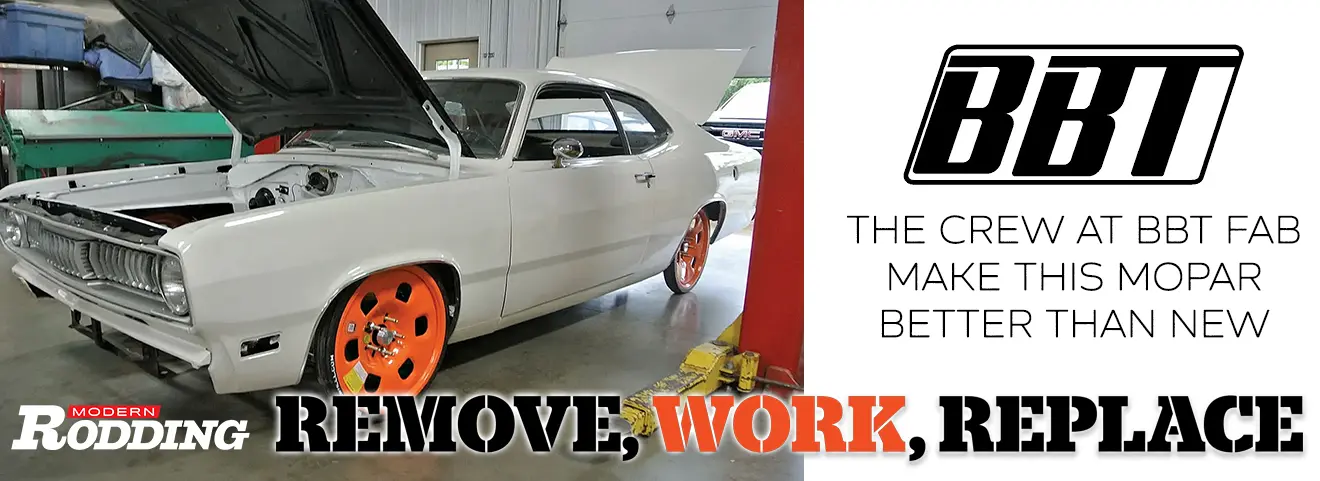
Fitting Fresh Sheetmetal Takes Know-How… and Patience


AMD Body Panels Help Lay the Foundation for a Hellcat-Powered 1971 Plymouth Duster

Read the full Modern Rodding Article HERE
High-horsepower builds often grab attention for what’s under the hood, but seasoned builders know the real success of any project starts with the structure underneath. BBT Fabrications understands this better than most, and their latest build—a 1971 Plymouth Duster commissioned by customer Jordan Dustin—proves exactly why quality sheetmetal and proper foundation work matter.
At first glance, the Duster appeared to be a clean, solid candidate. Finished in shiny white paint, it looked like an easy starting point. As is often the case with classic Mopars, that illusion disappeared the moment the car was stripped to bare metal. Hidden beneath the surface were extensive rust issues and poorly executed repairs, especially along the lower body panels.
This is where experience, patience, and the right replacement panels come into play.
When Looks Lie: The Reality of Vintage Mopar Sheetmetal
The 1971 Plymouth Duster uses a unibody construction, meaning the sheetmetal itself plays a critical role in structural integrity. While Chrysler’s original design worked fine for a factory 340ci small-block, it was never intended to support a modern, supercharged 6.2L Hellcat engine producing 717 horsepower.

Once the paint was removed, BBT Fabrications found widespread corrosion and thick layers of body filler hiding rust damage. In situations like this, knowing which panels can be repaired and which should be replaced is crucial—not just for appearance, but for long-term durability.
Fortunately, AMD offers strong aftermarket support for A-Body Mopars, making it possible to replace compromised panels with properly formed reproduction sheetmetal.
Upgrading the Foundation: Chassis and Floor Integration
Given the power goals of this build, the original unibody structure needed serious reinforcement. To handle the Hellcat drivetrain, BBT sourced a full-length G-Machine chassis from Schwartz Performance. This modern chassis provides:
-
Adjustable coilover front suspension
-
Tubular upper control arms with needle bearings
-
A triangulated rear suspension
-
Full-floating rear axle capability
To integrate this chassis correctly, a new AMD floor pan was installed. Custom channels were added to accommodate the new frame rails, ensuring proper alignment and load distribution throughout the body.
This step alone transformed the Duster from a compromised shell into a solid foundation capable of handling modern power levels.

AMD Sheetmetal: Rebuilding the Duster the Right Way
With the floor in place and the chassis mocked up, attention turned to the rest of the body. AMD reproduction panels were used extensively to replace rusted and damaged sections, including:
-
Quarter panels
-
Rocker panels
-
Rear doorjambs
-
Rear body panel
Some original components—such as the hood, roof, decklid, doors, and front fenders—were retained, but even those required significant metal finishing to meet the standards of the build.
Replacing panels on a Mopar A-Body isn’t about simply welding parts together. Achieving correct alignment, consistent gaps, and factory-correct contours takes time, careful measuring, and repeated test fitting.
Rust Prevention Starts Where You Can’t See It
One of the most overlooked aspects of sheetmetal restoration is what happens behind the scenes. To ensure longevity, all hidden panels were properly prepped and sealed with epoxy primer, preventing future rust from forming inside seams and cavities.
Door bottoms were replaced to address corrosion, followed by extensive door adjustment to achieve proper fitment. On vehicles over 30 years old, nothing is ever “bolt-on,” and patience is just as important as technical skill.

Experience Makes the Difference
Projects like this separate casual restorations from professional-grade builds. BBT Fabrications’ experience allowed them to identify problems early, choose the right AMD panels, and execute repairs that will stand the test of time.
For Mopar enthusiasts tackling similar builds—whether factory restoration or full restomod—this Duster is a reminder that quality sheetmetal is non-negotiable, especially when power levels far exceed original design limits.
AMD’s reproduction body panels provided the accuracy, fitment, and consistency needed to bring this A-Body back from the brink and prepare it for a new era of performance.
Frequently Asked Questions
Why replace panels instead of repairing rusted originals?
When corrosion compromises structural integrity or requires excessive filler, replacement panels provide a stronger, longer-lasting solution.
Are AMD panels suitable for high-horsepower builds?
Yes. Properly installed AMD panels restore structural integrity and are commonly used in restomod and performance applications.
Why is epoxy primer important on hidden panels?
Epoxy seals bare metal and helps prevent future corrosion inside seams and enclosed areas.
Final Takeaway
The real story behind this Hellcat-powered 1971 Plymouth Duster isn’t just the engine—it’s the foundation that makes the power usable. With expert craftsmanship from BBT Fabrications and high-quality AMD sheetmetal, this once-deceptive shell was transformed into a solid platform ready for modern performance.
For anyone restoring or modifying a Mopar A-Body, investing in proper sheetmetal isn’t just about looks—it’s about building something that lasts.
Related Articles
ALL NEW TRIM for your Mopar A-Body
Jan 3, 2025 by Jason
Tech Articles
Making an A-body Whole Again with Hard to Find Metal from AMD
Aug 29, 2024 by Jason
Tech Articles